
Squarespace SEO: A Practical Guide for Small Businesses

Squarespace provides a strong technical foundation for SEO while keeping website management relatively simple. The platform automatically handles features such as XML sitemaps, SSL, mobile optimization, and structured data, while also giving you control over SEO titles, descriptions, URL slugs, redirects, and image alt text.
However, improving search visibility still requires consistent work on content, keywords, website structure, and performance. Squarespace also provides less control over some advanced technical SEO settings and does not include dedicated traditional keyword rank tracking.
This guide explains Squarespace’s built-in SEO capabilities and limitations, how to optimize your site, how to track your results, and how rankingCoach can help you improve your online visibility.
Table of Contents
- What Is Squarespace?
- Squarespace SEO: Built-In Features and Limitations
- How to Do SEO on Squarespace
- How to Track Your Squarespace SEO Progress
- How rankingCoach Helps Squarespace Sites
- Squarespace SEO: Frequently Asked Questions
- Get Started with rankingCoach
1. What Is Squarespace?
Squarespace is a cloud-based website builder and hosting platform founded in 2003. It is particularly popular with creatives, photographers, restaurants, service businesses, and other users who want a visually polished website without having to manage hosting or website infrastructure themselves.
Like other hosted platforms, Squarespace manages infrastructure, security, and software updates. Users build their sites with templates and a block-based editor, while features for e-commerce, bookings, portfolios, and blogging are available within the platform.
Squarespace also includes a solid set of native SEO features. Automatic XML sitemaps, SSL, mobile optimization, metadata controls, editable URL slugs, redirects, structured data, and Google Search Console integration provide a useful foundation for small business SEO.
2. Squarespace SEO: Built-In Features and Limitations
Squarespace handles many technical SEO requirements automatically and provides controls for several important on-page elements. Understanding what the platform already provides and where its limitations are can help you focus your SEO work more effectively.
What Squarespace provides
Squarespace includes several useful SEO capabilities:
- SEO titles and descriptions
- Editable URL slugs
- Automatic XML sitemap
- SSL and HTTPS
- Mobile-optimized website design
- Image alt text
- 301 and 302 URL redirects
- Automatic structured data
- Google Search Console integration
- Built-in website analytics
- SEO Report and AI-assisted suggestions
- AI Visibility tools
- Crawler and search visibility settings
These features cover many of the technical requirements of a typical small business website without requiring plugins or extensions.
Advanced crawler control is limited
Squarespace manages the site’s robots.txt file automatically and provides settings for controlling some crawler behavior, including options related to search visibility and AI crawlers.
However, it does not provide the same level of direct robots.txt and server-level crawler configuration available on more extensible content management systems.
For most small business websites this is unlikely to be a major issue, but it can matter when more advanced crawl management is required.
Blog URLs follow Squarespace’s collection structure
Squarespace lets you customize individual blog post slugs and configure the default URL format used for posts.
Blog posts are normally associated with their blog collection’s URL structure, so changes to the blog page or its URL structure can affect post URLs. Plan your blog structure carefully and use redirects when changing established URLs.
Structured data is automatic but customization is limited
Squarespace automatically generates structured data for supported content types, including blog posts, events, products, local businesses, organizations, and website information.
This can help search engines understand your content and can make eligible pages available for richer search-result features.
The limitation is customization. Squarespace manages its automatically generated structured data rather than providing a comprehensive built-in schema editor. Websites requiring advanced or specialized Schema.org implementations may therefore need additional technical work.
No dedicated traditional keyword rank tracker
Squarespace provides search-performance information through its Google Search Console integration and also offers AI Visibility features for AI-powered search.
However, it does not provide the same type of dedicated traditional keyword rank tracker used to consistently monitor specific Google keyword positions over time.
If organic keyword rankings are an important KPI, use a dedicated rank tracking solution alongside Squarespace.
SEO Report and AI suggestions
Squarespace’s SEO Report can help identify missing SEO descriptions and image alt text. AI-assisted features can also suggest content for these fields.
This makes it easier to identify common on-page SEO gaps, but you should still review suggestions carefully to ensure they accurately describe your pages, images, and business.
AI Visibility
Squarespace also provides AI Visibility functionality for understanding how a website appears in AI-powered search.
The tool can check how often your website is mentioned in responses to relevant prompts, its ranking in ChatGPT or Gemini search results, and an AI search visibility score. Availability and usage can depend on your Squarespace version, website plan, language, and available AI credits.
3. How to Do SEO on Squarespace
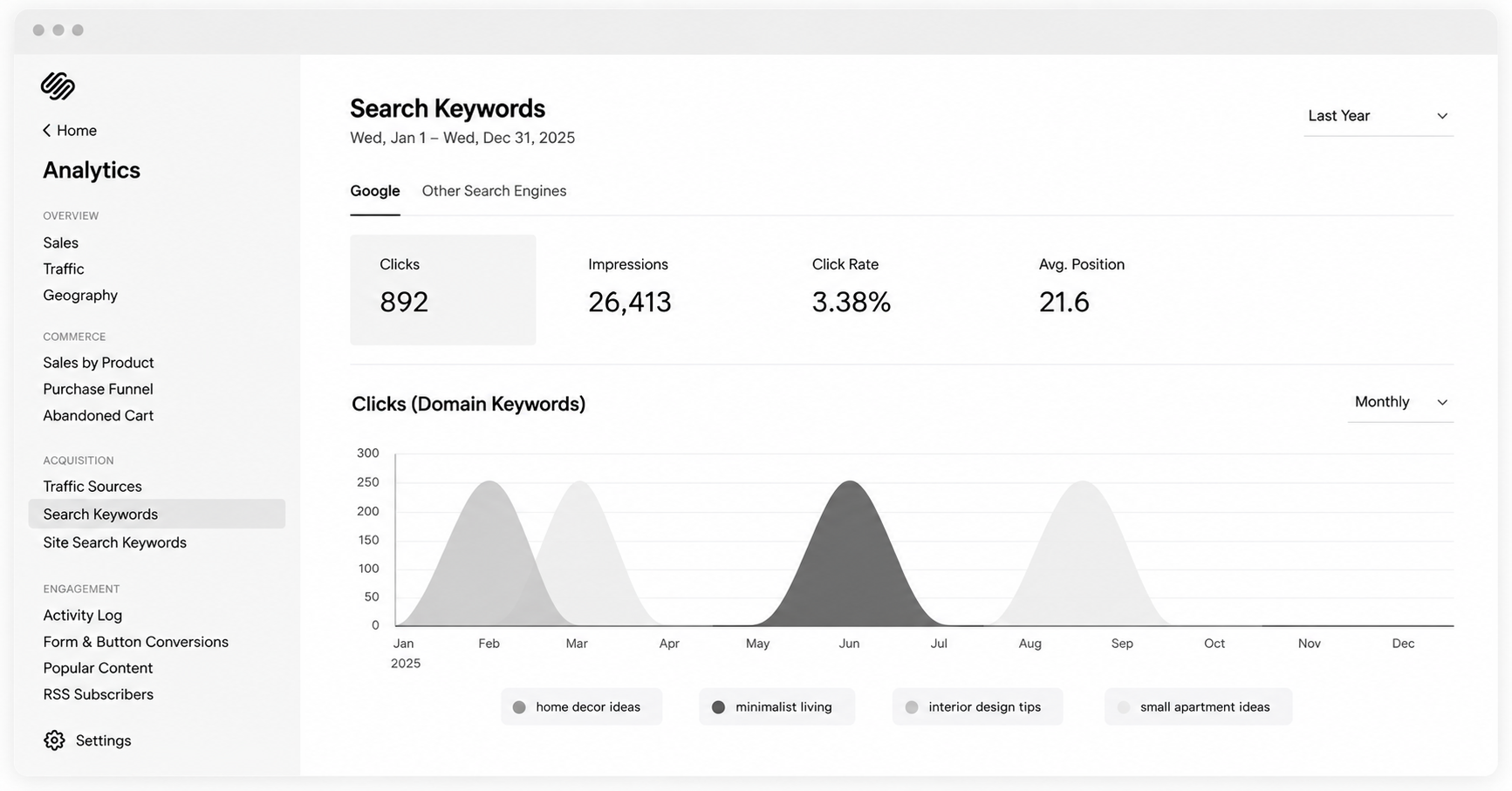
Squarespace handles much of the technical foundation automatically, but your content, keywords, website structure, metadata, and internal links still require deliberate optimization.
Set SEO titles and descriptions
Create a unique SEO title and description for each important page, blog post, product, event, or other relevant content type.
Your SEO title should clearly communicate the main topic of the page and include relevant search terms naturally. Write a useful meta description that accurately summarizes the content and gives potential visitors a reason to click.
Avoid treating character counts as strict rules. Focus instead on making titles and descriptions concise, relevant, and useful.
How to edit the meta description of a Squarespace page
Add keywords naturally to your content
Squarespace does not require a separate meta keywords field for SEO. Instead, use your target topics and relevant search terms naturally throughout the content.
Include them where they help describe the page, such as in the page title, relevant headings, body content, and internal links.
Avoid forcing the same keyword into specific locations or repeating it unnecessarily. The goal is to create content that clearly addresses what the visitor is searching for.
Write descriptive alt text for images
Add meaningful alt text to relevant images through Squarespace’s image settings.
Describe the image and its purpose accurately rather than adding keywords purely for SEO. Good alt text helps search engines understand images and improves accessibility for visitors who use screen readers.
Squarespace’s SEO Report can also help identify images where alt text is missing and provide AI-assisted suggestions.
Customize your URL slugs
Squarespace lets you customize URL slugs for pages and many content types.
Keep URLs short, descriptive, and easy to understand. When possible, establish your URL structure before publishing important content so you do not need to change established URLs unnecessarily.
Use redirects when URLs change
Squarespace supports 301 and 302 URL redirects.
If you permanently change an existing URL, create an appropriate 301 redirect from the old address to the new one. This helps visitors and search engines reach the correct page instead of encountering a broken URL.
Redirect mappings can also be useful when reorganizing collections or changing larger groups of related URLs.
Use headings to organize your content
Use headings and subheadings to create a logical content hierarchy.
The main heading should clearly describe the page topic, while lower-level headings can divide longer content into meaningful sections.
A clear heading structure makes your content easier for visitors to scan and helps search engines understand how the topics on the page relate to one another.
Build internal links
Connect related pages using descriptive internal links.
For example, a service page can link to relevant FAQs, case studies, blog articles, or contact information. Internal links help visitors discover useful content and help search engines understand relationships between pages.
Use your automatically generated sitemap
Squarespace automatically creates and updates an XML sitemap as content is added or removed.
You can submit your sitemap to Google Search Console to help Google discover your pages and monitor whether important content is being indexed.
Review your mobile experience
Squarespace sites are mobile-optimized by default, but you should still review important pages across different screen sizes.
Check navigation, text readability, images, buttons, forms, and other interactive elements to make sure the mobile experience works as intended.
Monitor website performance
Use PageSpeed Insights and Core Web Vitals data to identify performance issues on important pages.
Images, embedded content, third-party scripts, and other page elements can affect performance even when the platform itself handles much of the technical setup.
With a rankingCoach account, you can receive personalized SEO guidance based on your website and target keywords, helping you understand which optimizations to prioritize.
See how rankingCoach helps with Squarespace SEO →
4. How to Track Your Squarespace SEO Progress
SEO tracking helps you understand whether your optimizations are improving search visibility and bringing the right visitors to your website.
Use several sources together to build a complete picture of your performance.
Google Search Console
Connect your Squarespace website to Google Search Console to monitor:
- Search queries
- Impressions
- Clicks
- Average positions
- Indexing
- Core Web Vitals
Search Console can help you identify pages gaining visibility, queries generating traffic, and pages that may have indexing or performance issues.
How to connect your site to Google Search Console
Squarespace Analytics
Squarespace’s built-in analytics provide information about website visits, traffic sources, popular content, and other performance metrics.
Use this information to understand how visitors discover and interact with your website.
Google Analytics
You can also connect Google Analytics for additional information about visitor behavior and website performance.
Use Analytics alongside Search Console rather than treating them as interchangeable: Search Console focuses on performance in Google Search, while Analytics helps you understand what visitors do after arriving on your site.
Traditional keyword rankings
Squarespace does not provide a dedicated traditional keyword rank tracker for consistently following specific Google keyword positions.
Track your important target keywords over time and focus on longer-term trends rather than individual daily movements.
This can help you identify pages that are gaining visibility and pages that may need additional optimization.
AI search visibility
Squarespace’s AI Visibility functionality provides another view of search performance by showing how your website appears for relevant prompts in AI-powered search experiences such as ChatGPT and Gemini.
Traditional search rankings and AI visibility measure different types of discovery, so businesses increasingly benefit from monitoring both.
Competitor performance
Your own traffic and ranking data only tell you how your site is performing.
Monitoring competitors can help you identify keywords where other websites are gaining visibility, discover content opportunities, and understand how competitive your search market is.
Local visibility
If your Squarespace site represents a local business, monitor your Google Business Profile and make sure your business information is accurate across relevant directories.
Consistent business information makes it easier for customers and search platforms to identify your business correctly.
Online reputation
Monitor customer reviews and respond to feedback regularly.
Reviews can influence how potential customers perceive your business and are particularly important for companies competing for local customers.
With a rankingCoach account, you can track keyword positions and competitor performance alongside your SEO tasks, helping you connect changes in visibility with the optimizations you are working on.
Explore keyword rank tracking with rankingCoach →
5. How rankingCoach Helps Squarespace Sites
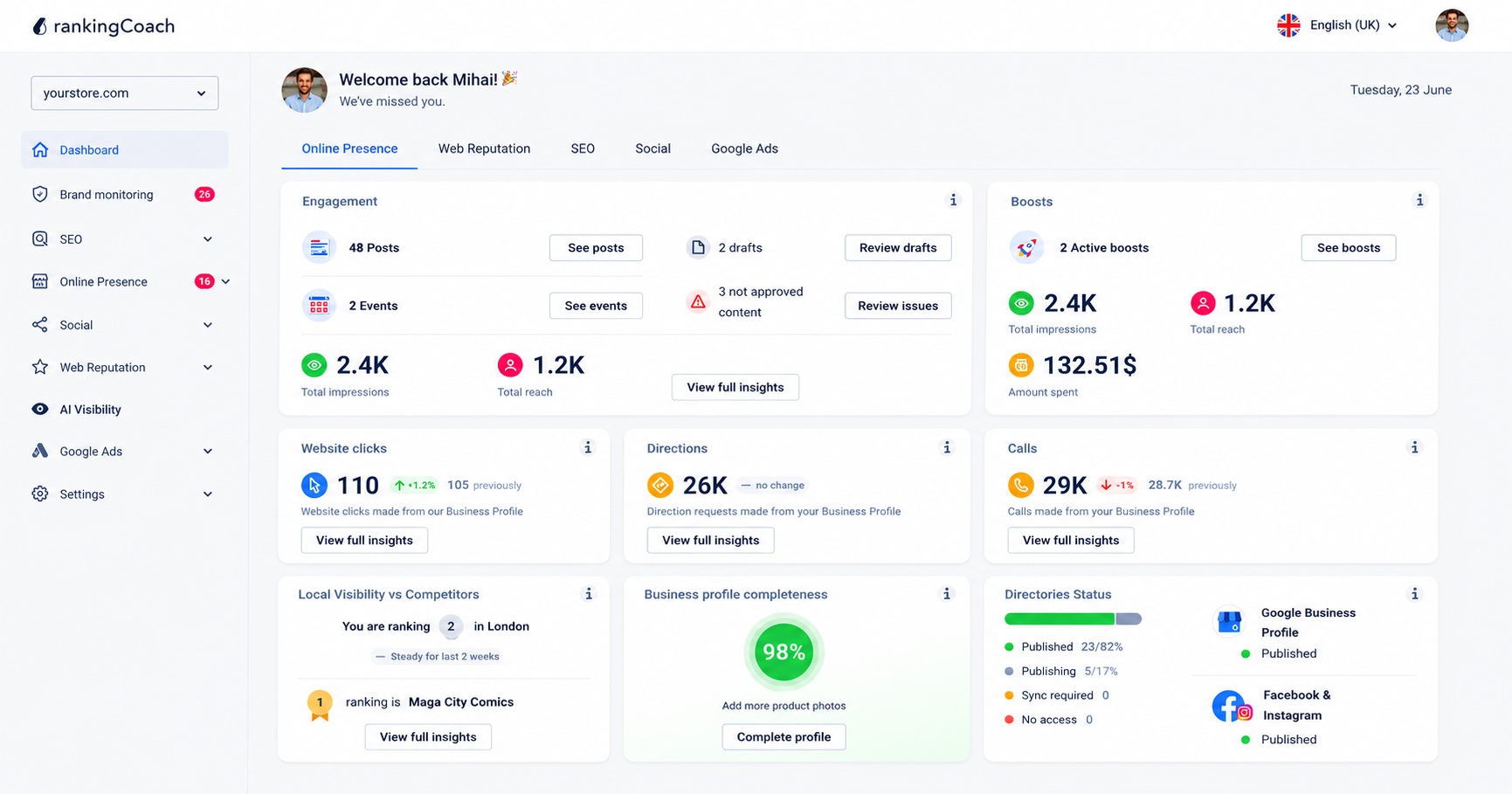
All major Content Management Systems (CMSs) are supported by rankingCoach, making your optimization plan the perfect fit for your system.
To get started, create or sign in to your rankingCoach account and follow the onboarding process, selecting Squarespace as your CMS when prompted. rankingCoach then analyzes your website and creates a personalized list of SEO tasks based on the opportunities it identifies.
Each task includes step-by-step written instructions and video tutorials tailored to Squarespace, helping you understand what needs attention and where to make the changes in your Squarespace website.
Squarespace already handles many technical SEO fundamentals automatically. rankingCoach complements these capabilities by helping you prioritize your SEO work, monitor traditional keyword rankings and competitors, and manage other areas of your online presence from the same platform.
Depending on your rankingCoach plan, you can also manage other areas of your digital marketing.
Key rankingCoach features
- Keyword rank tracking: Monitor where your Squarespace site ranks for your target keywords and track movement over time.
- Competitor monitoring: See how your site compares to competitors in search results and identify keywords they rank for that you do not.
- Business listings management: Keep your details accurate and consistent across Google, Bing, Facebook, and 30+ directories automatically.
- Review and reputation management: Monitor reviews across platforms and respond quickly with AI-assisted reply suggestions.
- Social media and Google Ads: Publish social media content, schedule posts, and manage Google Ads campaigns from one dashboard.
- AI Visibility: Monitor how AI-powered platforms such as ChatGPT, Perplexity, and Gemini represent your business and identify visibility opportunities.
- AI Agent: Automate supported SEO and marketing activities from rankingCoach.
See how rankingCoach brings it all together →
6. Squarespace SEO: Frequently Asked Questions
Is Squarespace good for SEO?
Yes. Squarespace provides a solid technical foundation for SEO, including automatic XML sitemaps, SSL, mobile optimization, SEO titles and descriptions, editable URL slugs, redirects, structured data, and Google Search Console integration. It also provides SEO Report and AI Visibility features. More advanced technical customization and dedicated traditional keyword rank tracking may require additional tools.
How do I do SEO on Squarespace?
Start by optimizing the SEO title and description of each important page. Create useful content around relevant search topics, use clear headings, customize descriptive URL slugs, add appropriate image alt text, and build internal links between related pages. Use Squarespace’s automatic sitemap and connect Google Search Console to monitor search performance. A dedicated rank tracking tool can help you monitor specific keyword positions over time.
Does rankingCoach work with Squarespace?
Yes. rankingCoach works with Squarespace without requiring a rankingCoach plugin or app in your Squarespace website. Create or sign in to your rankingCoach account and follow the onboarding process, selecting Squarespace as your CMS when prompted. rankingCoach then provides SEO tasks, written instructions, and video tutorials tailored to Squarespace.
What digital marketing features does rankingCoach offer for Squarespace users?
rankingCoach brings SEO and other digital marketing activities into one platform for small and medium-sized businesses. Depending on your subscription, this can include SEO guidance and keyword tracking, competitor monitoring, local listings, reputation management, social media, Google Ads, brand monitoring, and AI Visibility.
Is rankingCoach free for Squarespace users?
Yes. rankingCoach offers a free plan with core SEO and visibility functionality, while paid plans provide access to additional features and marketing tools. There is no rankingCoach plugin or app to install in Squarespace. Create or sign in to your rankingCoach account and select Squarespace as your CMS when prompted during onboarding.
7. Get Started with rankingCoach
Squarespace provides many of the technical foundations needed for SEO, but improving your search visibility still requires knowing what to optimize, monitoring your results, and understanding how you compare with competitors.
rankingCoach helps turn identified SEO opportunities into a clear action plan so you know what to work on next.
All major Content Management Systems (CMSs) are supported by rankingCoach, making your optimization plan the perfect fit for your system. Create or sign in to your rankingCoach account and follow the onboarding process, selecting Squarespace as your CMS when prompted. rankingCoach then provides personalized SEO tasks with written instructions and video tutorials tailored to Squarespace.
Whether you want to improve existing rankings, discover new keyword opportunities, monitor competitors, or strengthen your wider online presence, rankingCoach gives you the guidance and tracking tools to keep moving forward.